Artificial intelligence is moving beyond experimentation in pharmacovigilance. Regulatory authorities are exploring new AI applications, while pharmaceutical companies are adopting intelligent tools to streamline safety monitoring. From automated literature screening to AI agents that manage complex workflows, these technologies are reshaping how pharmacovigilance professionals work.
AI Is Changing the Way Pharmacovigilance Works
Pharmacovigilance has always involved processing large amounts of information. Scientific publications, individual case safety reports (ICSRs), safety databases, and regulatory documents all contribute to understanding the safety profile of medicinal products. However, reviewing this information manually can consume significant time and resources.
Artificial intelligence (AI) is changing how these activities are performed. From identifying safety-relevant publications to extracting adverse reaction data, AI can support tasks that traditionally require extensive manual review.
This development is also attracting increasing regulatory attention. At its 21st Industry Stakeholder Platform meeting on 20 October 2026, the European Medicines Agency (EMA) presented its latest initiatives involving AI in pharmacovigilance. The update demonstrated that AI is moving beyond theoretical discussions towards practical applications within regulatory workflows.
For pharmaceutical companies and pharmacovigilance professionals, this raises an important question: how can AI make safety monitoring more efficient while maintaining the quality and reliability of safety assessments?
What Is EMA Doing with AI in Pharmacovigilance?
During the October 2026 meeting, EMA outlined several areas where artificial intelligence could support pharmacovigilance activities. These include literature screening, duplicate detection, adverse drug reaction (ADR) extraction, case assessment, and signal detection.
Importantly, some of these applications have already reached the pilot deployment stage.
Two examples presented by EMA illustrate this progress:
- EurEKA (European Union Product Information Entity Extraction and Knowledge Acquisition) extracts adverse reaction information from Summary of Product Characteristics (SmPCs) and makes it searchable. The pilot has mapped approximately 155,000 ADRs across around 1,500 medicinal products.
- ERATO (Enhanced Review of Abstracts with Transformer Models) uses generative AI to screen scientific literature for emerging safety signals. Its pilot has reduced the number of abstracts requiring manual review by approximately 70%.
These examples demonstrate how AI can help regulatory authorities manage large volumes of safety information and focus human resources on more relevant findings.
EMA is also developing a framework and catalogue to support the sharing and reuse of AI tools across the European medicines regulatory network.
Where Can AI Be Used in Pharmacovigilance?
The potential applications of AI extend across several stages of the pharmacovigilance workflow. Its value is particularly evident in activities involving large datasets, repetitive processes, and unstructured information.
1. Literature screening and relevance assessment
AI can analyse scientific publications and identify those containing potentially relevant safety information. This helps pharmacovigilance teams prioritise articles for further review rather than manually examining every search result.
2. ICSR identification and data extraction
AI can identify potential individual safety cases described in scientific publications and extract relevant information about patients, medicinal products, adverse reactions, and special situations. This information can support the preparation of structured case records.
3. Signal detection and prioritisation
AI can help identify patterns across different sources of safety information, including scientific literature, historical assessments, and safety databases. These capabilities may support the identification and prioritisation of potential safety signals.
4. Documentation and reporting
AI can generate summaries, organise extracted information, and assist with preparing documentation. This can reduce repetitive administrative work and allow specialists to focus more on scientific assessment.
However, AI outputs should not automatically be treated as confirmed safety findings. Human review remains essential, particularly when decisions may affect patient safety or regulatory reporting.
From AI Tools to AI Agents: The Next Step in Pharmacovigilance Automation
Most traditional AI applications are designed to perform specific tasks. One tool identifies relevant publications, another extracts information, and another generates summaries.
AI agents in pharmacovigilance introduce a different approach. Rather than simply responding to individual requests, they can be configured to perform a sequence of tasks according to predefined instructions, rules, and workflows. In pharmacovigilance, this creates opportunities to automate repetitive activities across the literature monitoring process.
For example, an AI agent can be configured to review incoming publications, assess their relevance to pharmacovigilance, check their connection to monitored medicinal products, and suggest appropriate categories for further review.
The level of automation can also vary depending on the organisation’s requirements. Some teams may prefer AI to identify potentially relevant articles while leaving all categorisation decisions to specialists. Others may be comfortable with the agent performing additional steps under predefined rules and quality controls. This flexibility makes AI agents particularly interesting for pharmacovigilance teams managing multiple products, projects, and literature sources.
How DrugCard Uses AI to Support Pharmacovigilance Activities
DrugCard incorporates several AI-powered capabilities designed to support different stages of literature monitoring. Rather than relying on a single AI function, the platform combines multiple tools to help pharmacovigilance teams process, assess, and document scientific publications.
AI-Based Literature Relevance Assessment
One of the first challenges in literature monitoring is determining which publications actually contain pharmacovigilance-relevant information.
DrugCard uses AI to assess incoming articles and indicate their potential relevance to pharmacovigilance. Specialists can filter and prioritise search results based on these assessments, making it easier to identify publications that require closer examination.
This approach helps reduce the time spent reviewing irrelevant materials while keeping the complete search results available for verification.
AI-Generated Article Summaries
Reviewing the full text of every publication can be time-consuming, particularly when monitoring multiple medicinal products across different countries.
DrugCard generates AI-powered summaries of scientific articles, highlighting their context, patient populations, key findings, and conclusions.
These summaries are available in English, including for publications originally written in other languages. This helps specialists understand the main content of an article before deciding whether a more detailed assessment is necessary.
AI-Generated Notes
Once an article has been identified as relevant, specialists often need to document the information supporting its categorisation.
DrugCard can generate structured AI notes based on the publication and the medicinal product being monitored. These notes organise key information into sections covering the patient, product, adverse reaction, and special situations, where applicable.
Specialists can review and edit the generated content before saving it, helping maintain consistent documentation across literature monitoring activities.
AI-Powered ICSR Data Extraction
Identifying a potential safety case in scientific literature is only the first step. Relevant information about the patient, the medicinal product, and the adverse reaction must also be extracted and assessed.
DrugCard’s AI analysis capabilities identify these elements within publications and present the extracted information in a structured format. When multiple potential cases are described in one article, they can be presented separately.
The extracted information can then be used to initiate an ICSR draft in DrugCard’s integrated Adverse Reactions database, reducing repetitive data entry while leaving verification and completion to the pharmacovigilance specialist.
AI Agent for Automated Literature Monitoring
Taking automation further, DrugCard introduces an AI Agent that can perform literature categorisation directly within the platform’s monitoring projects.
The agent operates using the sources and medicinal products already configured in the project. Teams can choose between three automation levels depending on their preferred degree of human involvement:
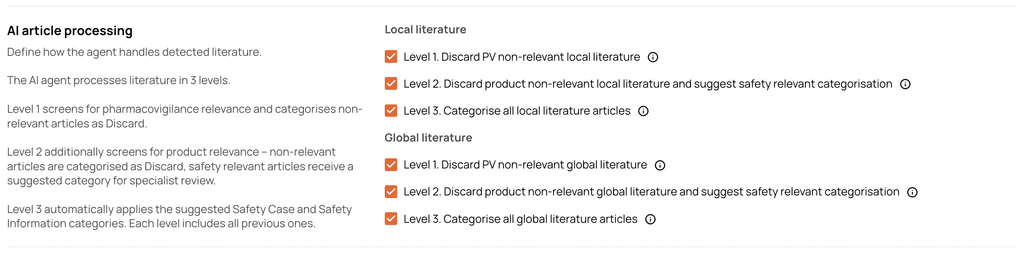
- Level 1 – Pharmacovigilance relevance screening: The agent identifies publications relevant to pharmacovigilance and discards those assessed as irrelevant.
- Level 2 – Product relevance and suggested categorisation: In addition to pharmacovigilance relevance screening, the agent identifies articles relevant to monitored products and suggests appropriate categories for safety-relevant publications.
- Level 3 – Automated categorisation: The agent automatically applies the suggested Safety Case and Safety Information categories.
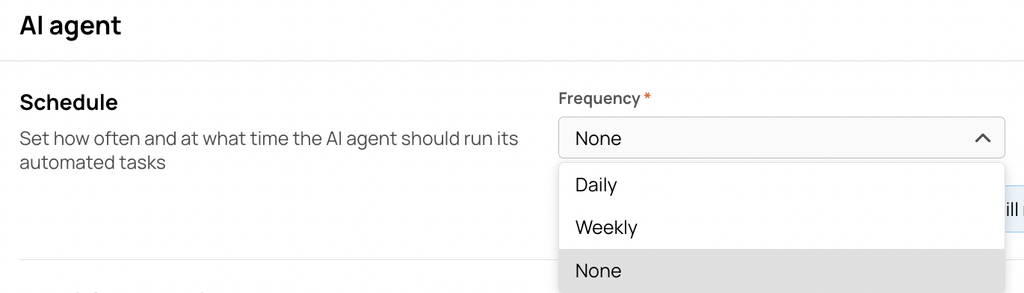
The agent can be configured separately for local and global literature monitoring. Teams can also schedule its runs daily or weekly, or initiate them manually.
Transparency is another important aspect. A dedicated dashboard displays processing progress, categorisation results, skipped or failed articles, and estimated time savings. Every run is recorded in the audit trail, providing traceability of the agent’s activities.
This approach allows pharmacovigilance teams to gradually increase automation while maintaining visibility and control over the process.
The Importance of Human Oversight and AI Validation
Despite its potential, AI is not a replacement for pharmacovigilance expertise. Regulatory authorities, including EMA, emphasise the importance of human accountability, validation, transparency, and data protection when introducing AI into safety-related processes.
During the October 2026 meeting, EMA highlighted several considerations for AI implementation:
- Validation: AI performance should be assessed using curated datasets and appropriate validation methods.
- False negatives: Particular attention should be paid to potentially relevant safety information that AI might fail to identify.
- Transparency: AI-supported decisions and activities should be sufficiently documented and traceable.
- Data protection: Patient information, especially personal data included in case narratives, requires appropriate safeguards.
- Human oversight: Pharmacovigilance professionals must retain responsibility for reviewing and evaluating safety information.
These considerations are especially important when implementing generative AI, which can produce convincing but incomplete or inaccurate outputs.
DrugCard follows a human-in-the-loop approach across its AI-assisted workflows. AI-generated assessments, notes, and extracted case information support the specialist’s work but do not eliminate the need for professional review and confirmation.
What Does the Future Hold for AI in Pharmacovigilance?
EMA’s latest initiatives suggest that AI will become an increasingly important part of pharmacovigilance operations.
One of the most significant developments is EMA’s participation in a five-year Innovative Health Initiative project on AI-powered signal detection, scheduled to start in January 2027. The project will involve regulators, pharmaceutical companies, academics, and other stakeholders.
Its expected outcomes include signal detection models, risk prediction approaches, implementation recommendations, human oversight frameworks, and training materials.
EMA is also preparing a dedicated Questions and Answers document on AI in pharmacovigilance. Following stakeholder consultation and drafting activities, a public consultation is anticipated in 2027.
Together, these initiatives indicate a growing focus on practical AI applications supported by appropriate governance and regulatory oversight.
For pharmaceutical companies, the challenge will be to identify where AI can deliver meaningful improvements without compromising the reliability of safety monitoring. AI-powered platforms and agents can help address this challenge by reducing repetitive work, improving information processing, and supporting more efficient pharmacovigilance workflows.
Conclusion
AI in pharmacovigilance is moving from experimentation towards practical implementation. EMA’s recent initiatives, including EurEKA and ERATO, demonstrate how artificial intelligence can support literature screening, ADR extraction, and signal detection.
At the same time, AI-powered platforms are making these capabilities increasingly accessible to pharmaceutical companies and pharmacovigilance service providers.
DrugCard combines AI-based relevance assessment, article summaries, structured information extraction, AI-generated notes, and automated literature categorisation through its AI Agent.
The objective is not to replace pharmacovigilance specialists, but to reduce repetitive tasks and give them more time to focus on what matters most: evaluating safety information and protecting patient health.
As AI technology continues to develop, the combination of intelligent automation, regulatory oversight, and human expertise will play an increasingly important role in the future of pharmacovigilance.