On 11 November 2026, Artem Horilyk, Co-founder and Chief Product Officer of DrugCard, spoke at the 20th National Congress of Pharmacovigilance and Technovigilance in Mexico, organised by the Mexican Pharmacovigilance Association (AMFV A.C.).
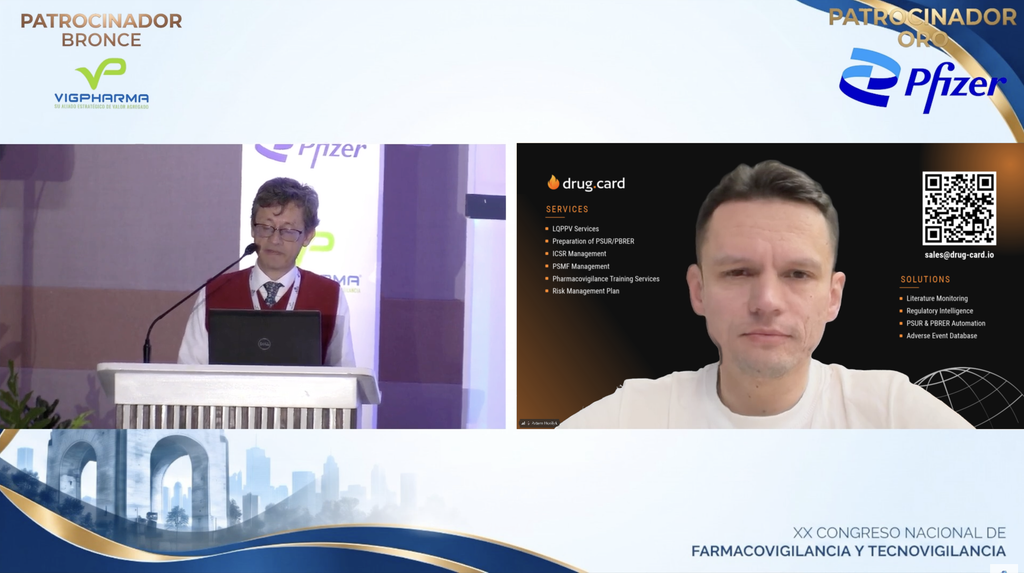
In his presentation, “Augmenting PV Literature Surveillance with AI Agents”, Artem shared what 1.4 million categorisation decisions have taught DrugCard about trust, autonomy and validation when AI takes part in literature monitoring.
1. A needle in a haystack
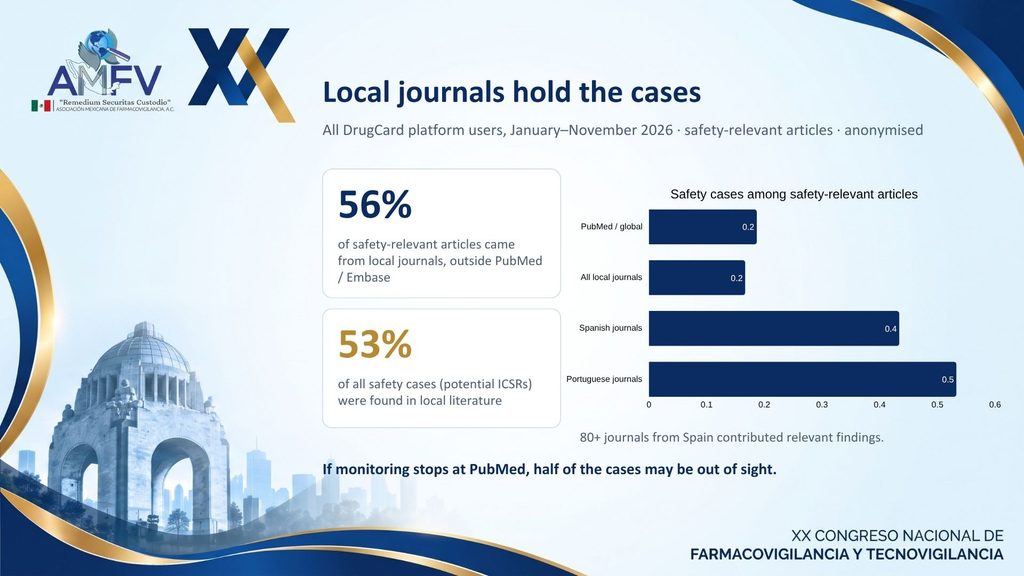
From January to October 2026, DrugCard’s PV literature service made 1,427,666 categorisation decisions. Only 0.18% of them were safety-relevant, and 181 were potential ICSRs, about 1 in every 7,900 decisions. Every article still has to be read, and the relevant ones cannot be missed.
The relevant articles often don’t come from global databases. Across all DrugCard platform users, 56% of safety-relevant articles and 53% of potential ICSRs were found in local journals outside PubMed and Embase. If monitoring stops at PubMed, half of the cases may be out of sight.
2. From classifier to agent
A classifier only answers whether an article is relevant. DrugCard’s AI agent does the job itself: it works as a dedicated system user, assigns categories, writes a rationale for each decision, logs every action in the audit trail, and goes through the same QC as PV specialists. Anything it cannot process stays with humans.
Full autonomy in pharmacovigilance is not a technical problem but a legal one, because the accountability of the MAH and QPPV cannot be delegated to an algorithm. That is why DrugCard offers three configurable levels, set per project:
- Level 1, General PV screening: discards articles that are not PV-relevant.
- Level 2, Product screening + suggestion: also discards product-irrelevant articles and marks potential cases as “AI suggested” for the specialist.
- Level 3, Full categorisation: the agent applies Safety Case and Safety Information categories itself, under QC.
3. Validated before release
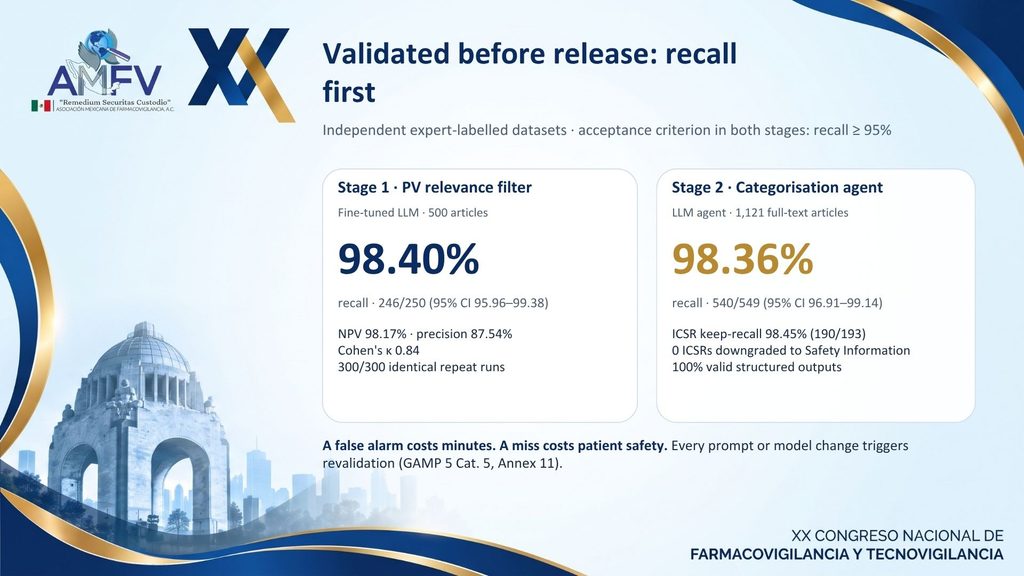
Both AI components were validated on independent expert-labelled datasets, with recall of at least 95% as the acceptance criterion. The relevance filter reached 98.40% recall, and the categorisation agent reached 98.36%. No ICSRs were downgraded to Safety Information. Any model or prompt change triggers revalidation.
4. The agent joined the team
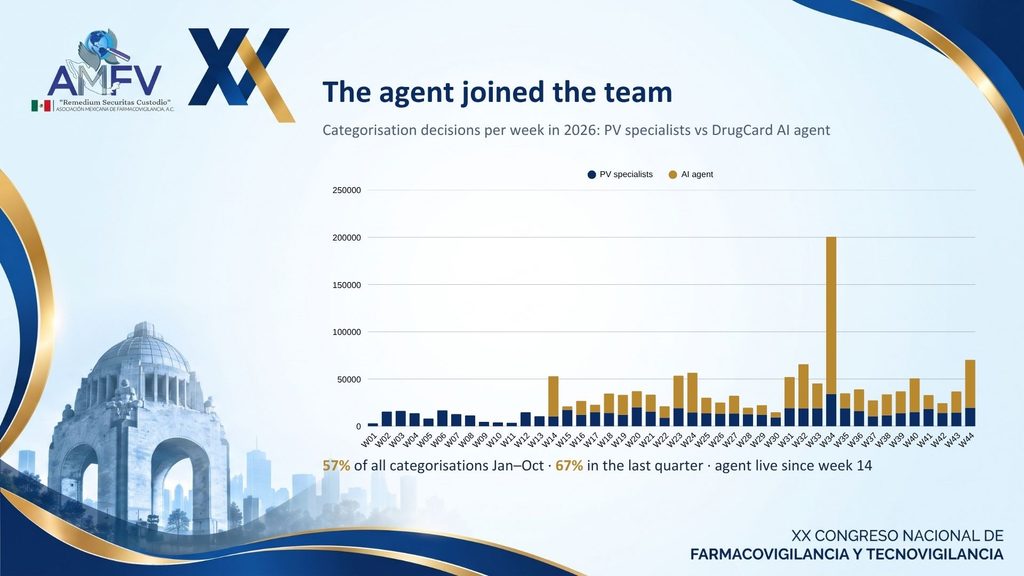
Since the agent went live in spring 2026, it has made 57% of all categorisations, and 67% in the last quarter. Weekly categorisations grew from 10,400 to 35,000, team output per specialist roughly tripled, and relevant findings grew from 20 to 72 per week.
The agent also proved its value under pressure. In August 2026, PubMed published 20 update files in one day, and about 400,000 articles landed in the database. That week the agent made 166,000 categorisations while the team kept its normal rhythm.
In production, the agent goes through QC just like a specialist. Reviewers checked 194,926 of its decisions and confirmed 98.7% of them, and no relevant articles were missed.
5. Seven questions before you let an agent decide
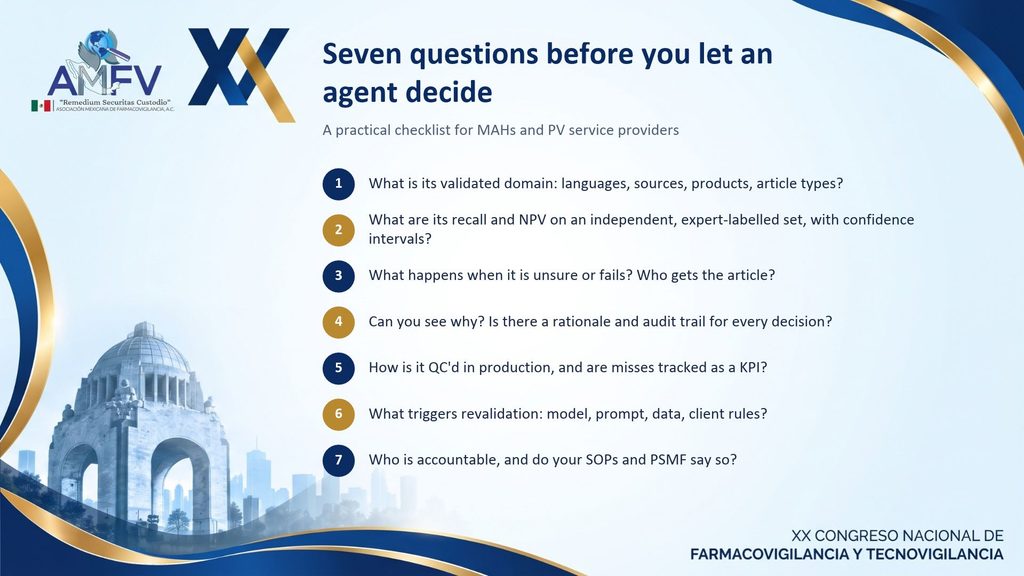
Artem closed the talk with a practical checklist for MAHs and PV service providers. It covers the agent’s validated domain, recall and NPV, fail-safe behaviour, explainability, QC in production, revalidation triggers and accountability.
Thank you, AMFV
“It was a pleasure to contribute to the event and exchange ideas with professionals who are working to move pharmacovigilance forward,” said Artem. “I hope this is the first of many opportunities to connect and collaborate.”
We thank Luis Ernesto Rozo Maragua and the entire AMFV team for the invitation, the warm welcome and the excellent organisation.
Interested in how AI agents can support your literature monitoring? Contact us to book a 30-minute intro call.